Current Groups & Movements
While 20th-century communist regimes largely collapsed, various organizations continue to promote or maintain ideological affiliation with core communist principles, often under rebranded labels such as democratic socialism or anti-capitalism.
These groups frequently echo the economic critiques and strategic approaches analyzed throughout this site: collective ownership of key industries, skepticism toward markets, institutional capture, and viewing capitalism as a system to be replaced rather than reformed. While not all openly advocate violent revolution, their platforms and internal factions often reveal direct continuity with historical Marxist-Leninist thought.
Commonly Associated Symbols
Many of the groups discussed use or tolerate historic communist symbols as markers of ideological continuity. These visuals often appear in protests, social media, literature, and organizational branding.

Traditional emblem of the union of industrial workers (hammer) and agricultural peasants (sickle). Widely used by CPUSA, PSL, and factional materials within DSA.

Symbol of revolutionary leadership and the guiding role of the vanguard party. Common in Leninist and Maoist iconography; appears in many communist party logos and protest signage.
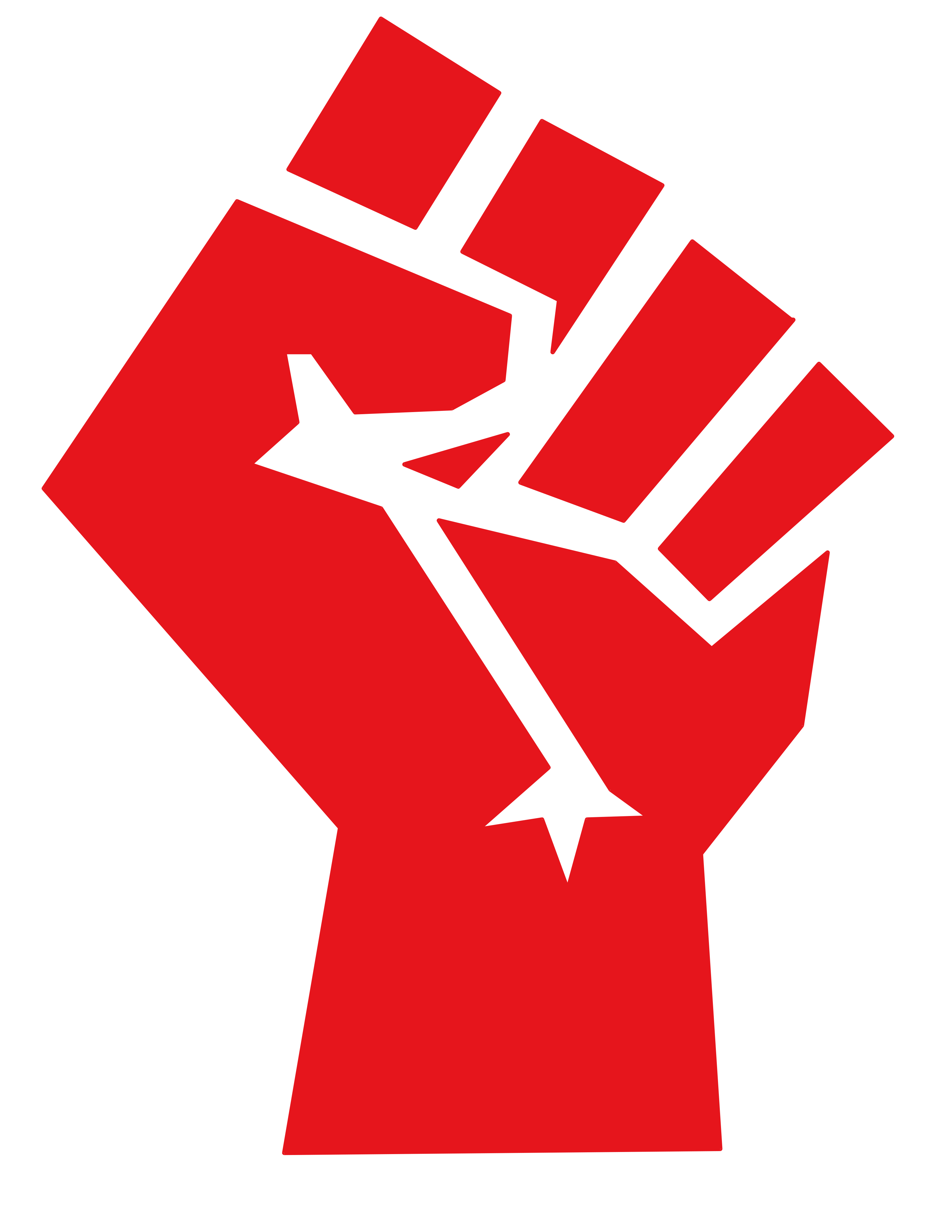
Represents solidarity, resistance, and class struggle. Ubiquitous across socialist and communist movements; frequently seen at DSA and allied events.

Classic banner of revolution and the working class. Still flown at rallies by explicitly communist organizations and in solidarity actions.
Democratic Socialists of America (DSA)
DSA describes capitalism as “a system designed by the owning class to exploit the rest of us for their own profit.” It calls for replacing it with democratic socialism featuring collective ownership of key sectors and “democratic planning.”
- Red Star Caucus (Marxist-Leninist): “Our primary goal… is to abolish capitalism and, ultimately, to achieve communism. We do not believe that capitalism can be reformed into socialism – it must be overthrown.” [source]
- DSA Communist Caucus: “Communism is the movement against class society. We want a stateless and classless society.” [source]
DSA prioritizes the “long march through institutions” — capturing labor unions, education, local government, and the Democratic Party. It frames reforms (Green New Deal, Medicare for All) as transitional steps toward post-capitalist society. It revisits the Communist Manifesto as relevant today and maintains an “anti-anti-Communist” heritage.
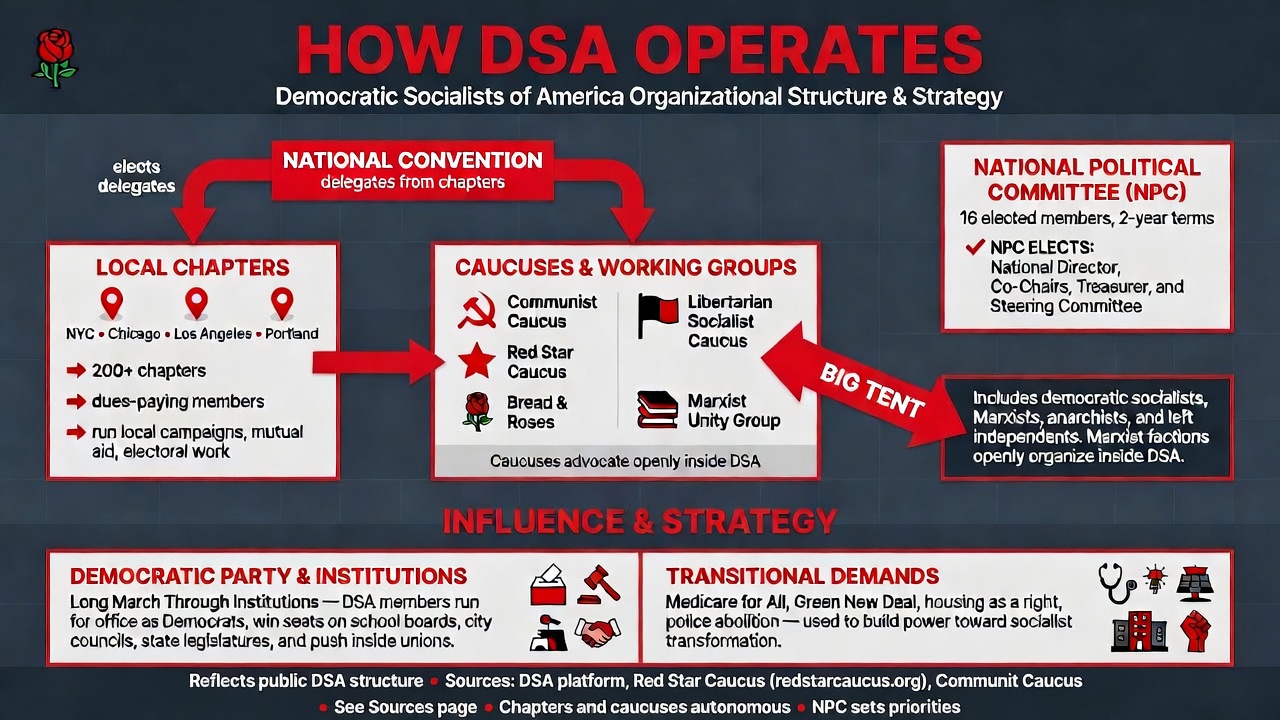
How DSA Operates: structure, factions, and strategy of influence. Based on public DSA platform and caucus materials (see Sources page).
DSA’s economic vision (collective ownership, planning over markets) and strategic approach (institutional capture + transitional reforms) closely track the core program outlined in the Communist Manifesto and developed in Leninist/Gramscian practice, even while operating inside electoral democracy.
Public Statements from DSA-Supported Candidates
Several prominent DSA members and endorsed candidates have made statements that echo or directly parallel foundational communist positions on capitalism, policing, and international issues. Examples include:
- On policing (2020): “We don’t need an investigation to know that the NYPD is racist, anti-queer & a major threat to public safety. What we need is to #DefundTheNYPD.” “There is no negotiating with an institution this wicked & corrupt. Defund it. Dismantle it. End the cycle of violence.” (Later moderated some positions as mayoral candidate; DSA criticized him for not going far enough.) [Tweet 1] [Tweet 2]
- On NYPD and Israel: “When the boot of the NYPD is on your neck, it’s been laced by the IDF.” [Video report]
- On socialism: “I was elected as a democratic socialist, and I will govern as a democratic socialist.” Disagreed with Reagan’s quote on government help being terrifying, countering with the terror of being unable to feed one’s family after working all day. [MSNBC clip]
- On “from the river to the sea”: Defended the phrase as “an aspirational call for freedom, human rights, and peaceful coexistence, not death, destruction, or hate.” (House of Representatives censured her in 2023 over use of the slogan post-Oct. 7.) [Tweet] [NPR report]
- Strong supporter of BDS movement; has called for ending all U.S. aid to Israel and described it as an “apartheid regime.” [Times of Israel]
- DSA San Francisco chapter: Endorsed Hamas actions as “decolonial action,” stating “Violent oppression inevitably produces resistance... This weekend’s events are no different. Decolonization is the only path towards peace.” [ADL backgrounder with quote]
- DSA toolkit guidance: “Liberating colonized land is a real process that requires confrontation by any means necessary.… Resistance comes in all forms—armed struggle, general strikes, and popular demonstrations. All of it is legitimate, and all of it is necessary.” (Settlers described as “military assets,” not civilians.) [Jacobin analysis with context]
- Broader DSA positions: Calls for defunding police budgets toward zero, freedom for incarcerated people, and treating addiction as health issue not criminal. [DSA Abolition Working Group]
These statements often frame issues through lenses of class struggle, decolonization, and systemic overthrow that mirror elements of historical communist rhetoric (e.g., viewing institutions as tools of oppression, capitalism as irredeemable, reforms as steps toward larger transformation). DSA has at times conditioned or withdrawn support from candidates seen as insufficiently aligned. See also the comparison table in the Modern Risks section.
Additional Examples
- On capitalism: “Capitalism has not always existed in the world and will not always exist in the world.” “So to me capitalism is irredeemable.” [The Independent / SXSW 2019]
- On socialism: “To me, what socialism means is to guarantee a basic level of dignity.” DSA has had tensions with her over Israel/Palestine positions, at times conditioning or withdrawing national endorsement. [City & State NY]
- “‘Defund the police’ is not the problem.” “We’re going to defund the police and refund our social services.” “Too many police in our country are more concerned with protecting white supremacy than serving the communities that pay their salaries.” [Senate Republican Leader archive of tweets] [Axios]
- “Defunding the police is about rebuilding our country in the image of our people.” Has taken “marching orders” from activist groups pushing to defund police. Linked policing to broader systemic issues. [Free Beacon]
- Examples like Darializa Avila (Mamdani-backed congressional candidate) had (later deleted) social posts calling for abolishing police and prisons, seizing private property, and abolishing borders. [CNN]
- DSA conventions and resolutions have demanded that endorsed candidates “openly and proudly identify with DSA and Socialism” and build “a socialist slate and political independence.” [Communis Press]
- DSA’s Abolition Working Group demands: “Defund the police by rejecting any expansion to police budgets or scope of enforcement while cutting budgets annually towards zero,” “End the criminalization of working-class survival,” and “Freedom for all incarcerated people.” [DSA site]
- Post-2023 convention resolutions pushed for candidates to openly identify as socialist and prioritize building toward socialism over incremental reforms within the Democratic Party. [Dissent Magazine]
Other Communist and Marxist-Leninist Organizations
In addition to DSA and its internal factions, several openly communist organizations actively promote Marxist-Leninist analysis, organize protests, participate in labor and social movements, and advance anti-capitalist and anti-imperialist agendas. Many participate in coalitions that overlap with or assist broader left and DSA-influenced campaigns through shared rhetoric, protest organizing, and institutional work.
The oldest communist organization in the US (founded 1919). Describes itself as Marxist-Leninist and advocates “Bill of Rights socialism.” Its 2025 program calls for replacing capitalism with socialism through “a strategy of struggle, unity, reform, and revolution.” Focuses on labor unions, racial justice, environmental activism, and opposing “corporate capitalism.”
- Recent activity includes local electoral campaigns and alliances with broader progressive movements.
- Program emphasizes unity against the “extreme right” and building an “anti-monopoly coalition.”
Revolutionary Marxist-Leninist party founded in 2004. Explicitly aims to abolish capitalism and replace it with a socialist system. Runs presidential and local candidates and is heavily involved in street protests, especially around Palestine solidarity, police abolition, and anti-imperialism.
- Organized and participated in major 2024-2026 protests; supported candidates including Claudia De la Cruz for President.
- Program states: “The aim of the PSL is to abolish the corrupt, rotten and anti-people capitalist economy, state and governmental system...”
- Active in coalitions with various left and “anti-war” groups.
Founded 1959 (split from Socialist Workers Party). Marxist-Leninist (Marcyite tendency). Advocates socialist revolution and supports historical communist states. Focuses on “workers and oppressed peoples of the world unite.”
- Long history of militant protest organizing and anti-imperialist work.
- Publishes Workers World newspaper; active in labor, anti-war, and social justice campaigns.
Marxist-Leninist organization formed in 1985 (New Communist Movement roots). Describes itself as fighting for “Revolution. Socialism. Liberation.” Aims to “build a new, revolutionary, communist party” in the United States. Active in labor, community control of police, and national liberation movements.
- Recent 10th Congress (2026) declared growth and leadership in “people’s movements” including George Floyd rebellion protests and anti-war actions.
- Strong emphasis on building united fronts and strategic alliances.
- Revolutionary Communists of America (RCA) — communistusa.org: Revolutionary organization explicitly preparing for “the coming American revolution” and the overthrow of capitalism. Part of an international network.
- American Party of Labor (APL) — americanpartyoflabor.com: Anti-revisionist (Hoxhaist) Marxist-Leninist party. Member of international ML organizations; focuses on building a vanguard party.
- Party of Communists USA (PCUSA): Maintains a detailed program for transition from capitalism to socialism to communism; emphasizes work in unions and cultural institutions.
International Examples
Parties in Greece (KKE), Portugal (PCP), Spain, and France maintain explicit Marxist-Leninist platforms and participate in electoral politics while advocating nationalization, exit from NATO/EU structures in some cases, and solidarity with regimes like Cuba and Venezuela.
Groups and governments influenced by “21st Century Socialism” or Bolivarian Alliance continue to promote heavy state intervention, expropriation, and anti-imperialist rhetoric rooted in communist analysis. Academic and activist networks in the West often provide ideological and material support.
- Economic Vision: Collective or state control over major industries and rejection of “unfettered” capitalism.
- Strategic Approach: Working inside existing institutions (unions, parties, universities, NGOs) to shift power.
- Ideological Continuity: Frequent references to Marx, Lenin, or Gramsci; defense of historical communist experiments as “distorted” rather than inherently flawed.
- Reform as Transition: Support for expansive social programs framed as steps toward a post-capitalist order.