Modern Risks to Western Civilization
Although most 20th-century communist states have collapsed, core ideas from the Marxist tradition have evolved and continue to influence Western institutions.
At a Glance
- Shift from economic to cultural Marxism after economic revolutions failed in the West
- Gramsci’s “long march through the institutions” became the dominant strategy
- Core ideas reframed: class → identity, merit → power, objective truth → social construct
- DSA as the largest U.S. example, with explicit Marxist-Leninist factions inside
- Pattern of institutional capture in education, media, HR, and government
- Market economies continue to dominate innovation (e.g. Nobel prizes in science)
From Economic to Cultural Marxism
When direct economic revolution failed in the West, Marxist thinkers shifted focus to culture. The Frankfurt School (Critical Theory) and Antonio Gramsci emphasized capturing cultural and educational institutions rather than seizing factories.
— Antonio Gramsci (attributed)
Revolutionaries must conduct a “war of position” — infiltrating and transforming the institutions of civil society (schools, universities, churches, media) before seizing state power. This became the dominant strategy after economic Marxism stalled.
— Gramsci (Prison Notebooks, paraphrased)
Key concepts that migrated:
Institutional Influence
These ideas spread through universities, teacher training, media, and eventually corporate and government policy.
Critical Theory derivatives in curricula, teacher training, and diversity programs. Viewpoint diversity pressured.
Narratives framing capitalism, family, religion, and merit as systems of domination.
Equity initiatives that prioritize group identity over individual rights and merit.
Skepticism toward national identity, borders, and Western historical achievements in policy debates.
“Tolerance is extended to policies, conditions, and modes of behavior which should not be tolerated because they are impeding... the chances of creating an existence without fear and misery.”
Why This Matters
Liberal Western civilization is built on individual rights, private property, free inquiry, and limited government. Many ideas descending from Marxism are philosophically hostile to these foundations.
“The long march through the institutions” — a strategy explicitly discussed in radical circles since the 1960s — has resulted in significant ideological capture of universities, K-12 education, HR departments, media, and parts of government. The goal remains the transformation (or deconstruction) of the existing order.
The pattern of promising liberation while delivering centralized control and the suppression of dissent remains visible in contemporary debates over speech, education, property, and identity.
Contemporary Manifestations
A clear modern example is the Democratic Socialists of America (DSA), the largest socialist organization in the United States. While it distances itself from 20th-century authoritarian regimes, its platform, rhetoric, and factions show significant ideological continuity with Marxist thought.
DSA's analysis mirrors classical critiques: “Capitalism is a system designed by the owning class to exploit the rest of us... We must replace it with democratic socialism.” This echoes Marx and Engels' call for abolition of private property in the means of production.
DSA operates as a “big tent” including explicit Marxist-Leninist groups:
- Red Star Caucus: “Our primary goal... is to abolish capitalism and, ultimately, to achieve communism.” [source]
- DSA Communist Caucus: “We want a stateless and classless society.” [source]
Other factions advocate overthrowing the U.S. constitutional order.
- Long march through institutions (unions, education, Democratic Party)
- Democratic planning and social ownership of key industries
- Reforms framed as “transitional demands” toward post-capitalism
- Retains core class struggle view alongside identity politics
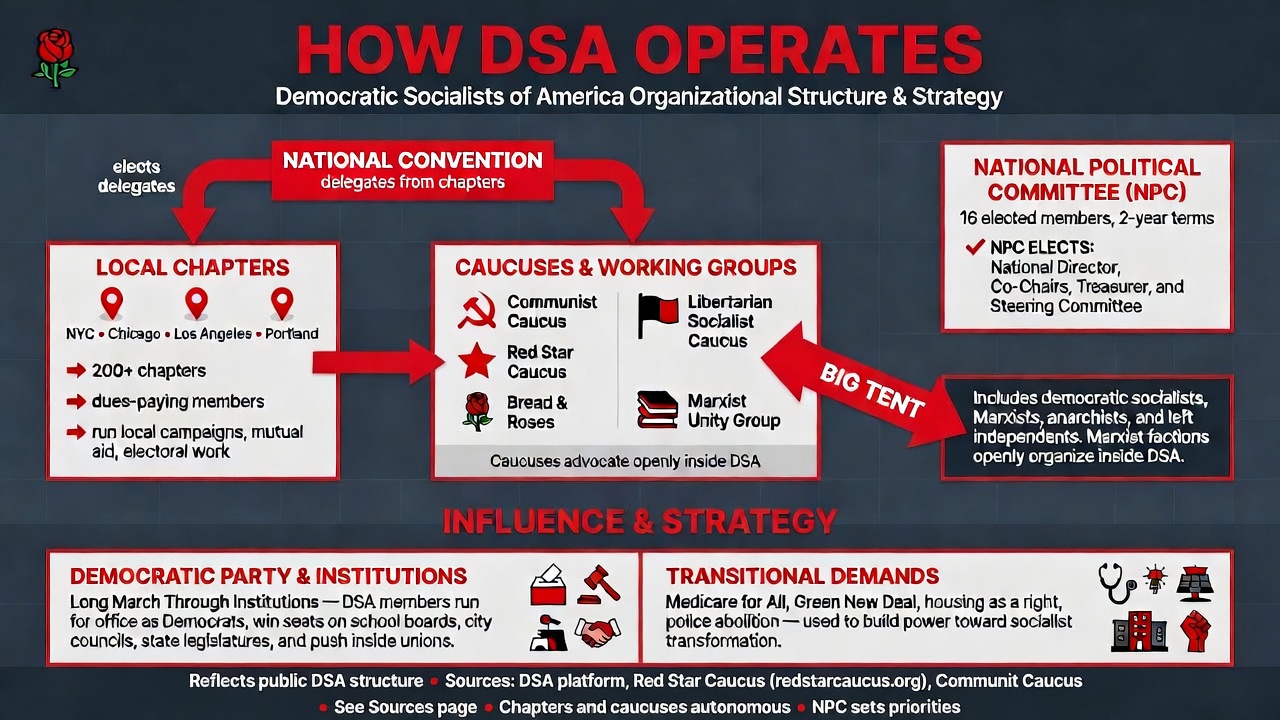
How DSA Operates: structure, factions, and strategy of influence. Based on public DSA platform and caucus materials (see Sources page).
DSA Agenda vs. Communist Principles
Side-by-side comparison using direct quotes and declared policies from DSA's platform and caucuses alongside core principles from communist theory and practice.
All DSA quotes drawn from official DSA descriptions, platform language, and public caucus statements. Communist side drawn from foundational texts and established Leninist/Gramscian strategy.
“We are socialists because we share a vision of a humane international social order based both on democratic planning and market mechanisms...”
Broader Patterns
Spread of critical pedagogy and identity frameworks that treat Western civilization as inherently oppressive. Parallels to cultural revolution tactics.
Promotion of narratives that frame capitalism, family, religion, and merit as systems of domination.
Calls for expansive state control over speech, economy, and equity initiatives that risk replicating historical patterns of coercion in softer forms.
Continued admiration or apologetics for regimes in China, Cuba, or Venezuela in some activist circles despite documented failures.
How to Spot a Communist
Public discourse frequently surfaces clear examples of ideological language that mirrors longstanding communist framing — systemic condemnation of capitalism, calls for fundamental overhaul, and identification of "oppressor" structures.
Science Nobels as Proxy for Open Inquiry
Market-oriented societies dominate scientific output. Illustrative data drawn from Nobel records. Free systems with decentralized inquiry have produced the overwhelming share of transformative advances.